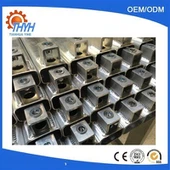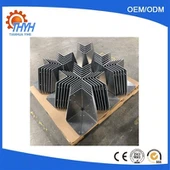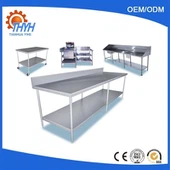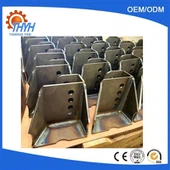
Solid-State Forming: Refers to processing methods utilizing raw materials-such as metal strips, sheets, or other solid forms-that can be shaped under ambient temperature conditions. This constitutes a labor-intensive mode of production, and the associated processing costs can be relatively low.
Classification of Solid-State Forming Processes
Spinning: A very common processing method used to produce radially symmetrical components, such as dishes, cups, and cones. During processing, a high-speed rotating metal sheet is pressed against a stationary mold-mounted on a lathe that is also rotating at high speed-to achieve a predetermined shape. This process is suitable for various production batch sizes.
Bending: An economical production process used to shape sheet, rod, or tubular materials of any configuration.
Continuous Roll Forming: A process in which a metal sheet is fed between pressure rollers to produce a metal profile of continuous length and uniform cross-section. It is similar to the extrusion process, though it is subject to limitations regarding the wall thickness of the processed component, yielding only a single, uniform wall thickness. Processing costs are most cost-effective when undertaken within the context of mass production.
Stamping: A process in which a metal sheet is placed between a male die (punch) and a female die (cavity) and pressed into shape; it is used to produce hollow forms, which may vary in depth from shallow to deep.
Punching: A process utilizing specialized tools to cut specific shapes out of a metal sheet; it is applicable to both large- and small-batch production.
Blanking: Fundamentally similar to the punching process, the distinction lies in the fact that punching utilizes the material *punched out* (the slug), whereas blanking utilizes the *remaining* portion of the metal sheet after the cut has been made.
Shearing: The act of cutting a metal sheet using a shearing action-analogous to using a pair of scissors to cut paper at a specific location.
Chip-Forming Machining: Collectively refers to cutting methods that generate metal chips (swarf) during the material removal process. These processes include turning, drilling, boring, milling, planing, broaching, sawing, grinding, lapping, honing, and polishing.
Non-Chip-Forming Machining: Processes that utilize existing metal strips, sheets, or similar materials to create shapes without generating metal chips. This category of processes includes chemical machining, etching, electrical discharge machining (EDM), abrasive blasting, laser cutting, waterjet cutting, and thermal cutting.