A buyer once sent us platform brackets for an offshore equipment skid. They measured within tolerance, welds looked sound, and the packing list was complete. Six months later, rust was bleeding from unstitched weld toes, drain holes were too small to clear spray, and the splash-zone coating was flaking. The cause was missing RFQ detail, not workmanship.
Most marine and offshore fabrication failures are preventable if the buyer clarifies environment, material, welding, finishing, and logistics before the purchase order.
After reviewing hundreds of fabrication packages for marine frames, equipment skids, access platforms, and pipe supports from OEM buyers across different markets, our engineering team at Qingdao Tianhua Yihe Metal Fabrication (qdthyhmetalfab.com) has seen five specification gaps that account for most field failures.
Those components - frames, skids, platforms, and pipe supports in carbon and stainless steel - sit in our marine and offshore fabrication range.
Reader's Checklist
| Item | Minimum specification | Why it matters |
|---|---|---|
| Environment zone | Atmospheric, tidal, splash, or submerged | Coating life is zone-dependent |
| Material grade + certificate | S355JR / Q355B or 316/316L; EN 10204 3.1 MTC with heat number | "Marine grade" is not a standard; traceability starts at the mill cert |
| Welding standard + inspection | WPS to AWS D1.3, EN 1090, or AS/NZS 5131; VT every weld, UT/MT if specified | Salt attacks weld toes first |
| Surface protection | HDG to ISO 1461 / ASTM A123 / AS/NZS 4680, duplex, paint, powder, or anodizing | One global note rarely covers every zone |
| Documentation | Weld maps, WPS refs, welder IDs, coating reports, dimensional report | Audits and warranty claims need records |
| Packaging & loading | Seaworthy crate, VCI, blocking, desiccant, loading photos | Salt humidity can damage parts in transit |
1. Design for the Environment, Not Just the Drawing
Offshore structures can see atmospheric, splash, tidal, and submerged zones in one frame. A drawing that only shows dimensions ignores the regime that controls service life.
Avoid standing water. Specify drain holes at the lowest point of every cavity; a 10 mm hole is a practical minimum so salt and debris do not plug it.
Eliminate crevices. Lap joints and unstitched weld toes trap chloride-laden moisture; require seal welds on hidden backsides.
Think about access. A bracket that is easy to weld but impossible to re-coat in the field will fail at the edges first.
Better approach: Add a corrosion-zone map to your drawing package and tie each surface to the protection note.
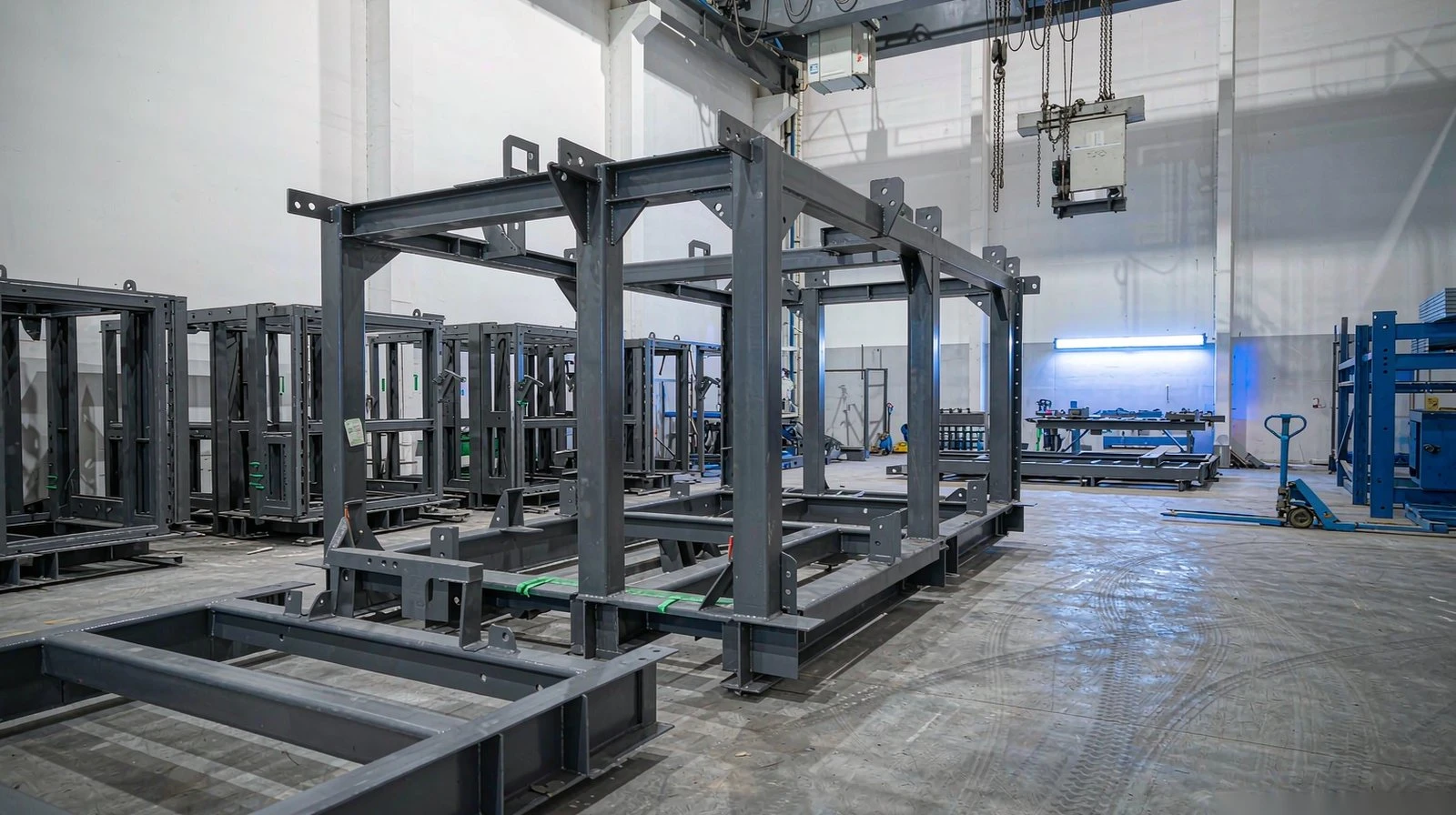
Skid and frame assemblies staged ahead of shipment. The specification that decides how long they last was fixed long before this point - coatings, drainage, and weld detail are drawing decisions, not shop-floor ones.
Reader's Checklist
| Item | Minimum specification | Why it matters |
|---|---|---|
| Environment zone | Atmospheric, tidal, splash, or submerged | Coating life is zone-dependent |
| Material grade + certificate | S355JR / Q355B or 316/316L; EN 10204 3.1 MTC with heat number | "Marine grade" is not a standard; traceability starts at the mill cert |
| Welding standard + inspection | WPS to AWS D1.3, EN 1090, or AS/NZS 5131; VT every weld, UT/MT if specified | Salt attacks weld toes first |
| Surface protection | HDG to ISO 1461 / ASTM A123 / AS/NZS 4680, duplex, paint, powder, or anodizing | One global note rarely covers every zone |
| Documentation | Weld maps, WPS refs, welder IDs, coating reports, dimensional report | Audits and warranty claims need records |
| Packaging & loading | Seaworthy crate, VCI, blocking, desiccant, loading photos | Salt humidity can damage parts in transit |
1. Design for the Environment, Not Just the Drawing
Offshore structures can see atmospheric, splash, tidal, and submerged zones in one frame. A drawing that only shows dimensions ignores the regime that controls service life.
Avoid standing water. Specify drain holes at the lowest point of every cavity; a 10 mm hole is a practical minimum so salt and debris do not plug it.
Eliminate crevices. Lap joints and unstitched weld toes trap chloride-laden moisture; require seal welds on hidden backsides.
Think about access. A bracket that is easy to weld but impossible to re-coat in the field will fail at the edges first.
Better approach: Add a corrosion-zone map to your drawing package and tie each surface to the protection note.
2. Material Grade and Certificate Clarity
"Marine-grade steel" means different things in different markets. For carbon-steel fabrications, S355JR or Q355B are common grades; 316 or 316L stainless suits severe chloride exposure. The certificate type matters as much as the grade.
EN 10204 3.1 confirms the mill's own test results and is sufficient for most OEM work.
EN 10204 3.2 adds independent inspection and is often required for classification projects.
The heat number must be traceable to the parts in the final assembly.
Better approach: List the exact grade, standard, and certificate type in the BOM.
3. Welding Standards That Survive Salt Air
Salt-laden air concentrates stress at weld toes and heat-affected zones. The right standard makes cracking far less likely.
Use a qualified WPS. Reference AWS D1.3, EN 1090, or your local equivalent such as AS/NZS 5131, backed by ISO 3834 welding quality management.
Preheat discipline. Verify preheat at least 25 mm or 1.5 times the plate thickness from the joint, whichever is larger, on both sides. Re-verify after any interruption.
Tack welds are real welds. A cold tack is a crack starter; preheat tacks like the root pass.
Postheat for demanding joints. For carbon equivalent above 0.55 or sections over 50 mm, a 250°C postheat hold drives diffusible hydrogen out. Hydrogen cracking can appear hours, days, or weeks after welding.
Inspection scope. Visual testing of every weld with a weld log is the baseline; UT/MT is available through audited partners on request.
See how we control welding quality in our heavy plate welding service.
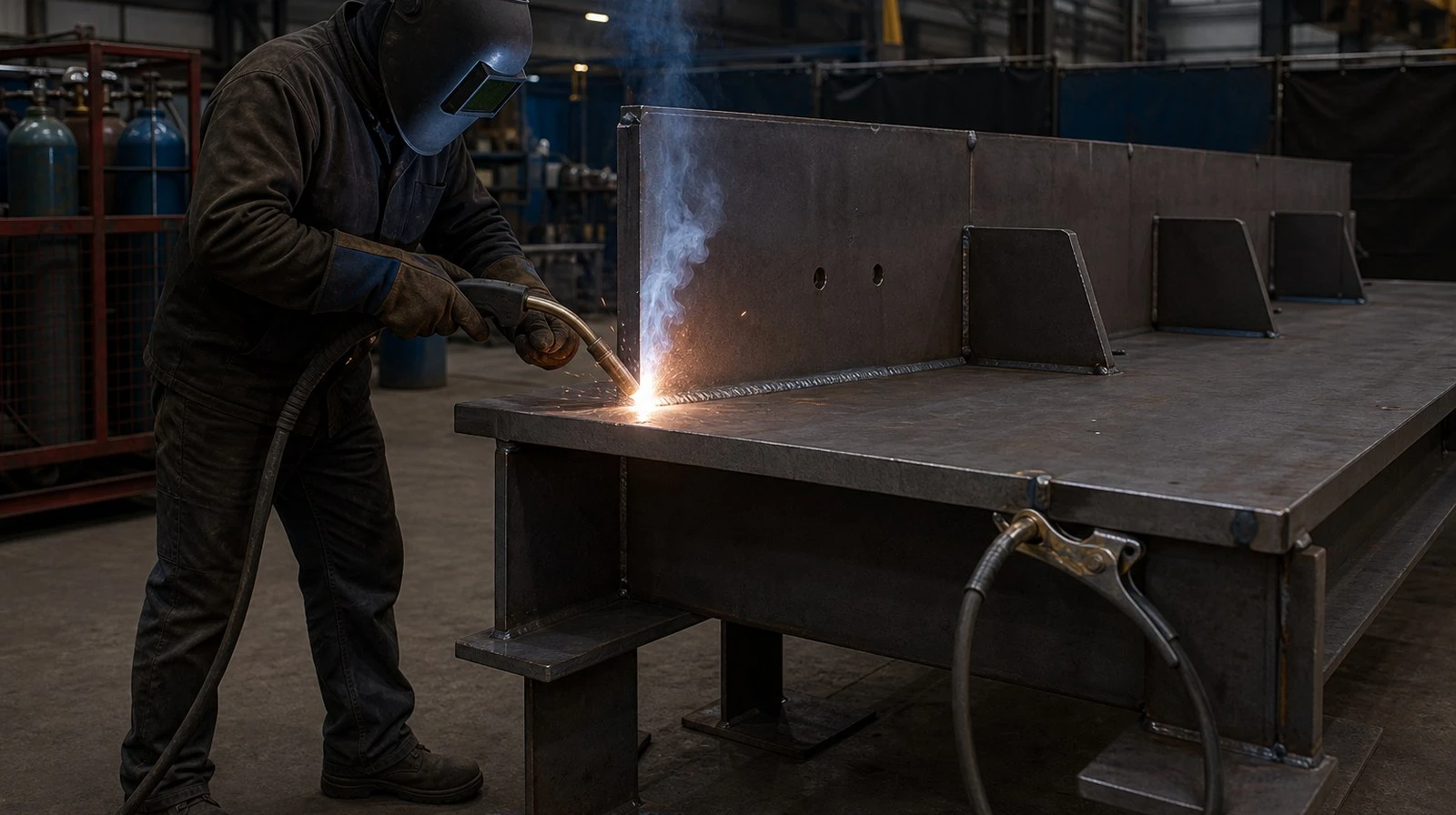
Vertical stiffeners on a skid top plate - the joint that cracks first if preheat and bead profile are left to chance.
4. Surface Protection: One Coat Is Rarely Enough
A single paint note is usually the weakest link in a marine specification. Different zones need different systems.
Hot-dip galvanizing (HDG). A proven base layer for atmospheric and splash-zone carbon steel. We run HDG in-house to ISO 1461, ASTM A123, and AS/NZS 4680. Specify a coating thickness range and check adhesion at edges and vent holes.
Duplex systems. HDG plus a compatible paint or powder topcoat extends life in the most aggressive zones.
Other finishes. Powder coating, liquid paint, and anodizing suit different base metals and environments.
Better approach: Define the protection system by corrosion zone, not one global note, and require a coating thickness report.
5. Documentation and Traceability
Offshore fabrications are audited long after they leave the factory. A strong document package protects both parties.
Weld traceability. Weld map, WPS reference, welder ID, and VT record for each weld.
Material traceability. Heat numbers linked to each part or batch.
Coating records. Pre-treatment, coating thickness readings, and adhesion test results.
Dimensional report. Measured values against datum for bolted interfaces.
Better approach: Ask for a sample document package with the first article.
6. Packaging and Logistics for Seaworthy Arrival
A good part can still arrive damaged after weeks in a salt-air container. The supplier owns packing; the buyer should own the spec.
Seaworthy packaging. Wooden crates with VCI film, desiccant, and blocking to prevent movement and contact corrosion.
Loading evidence. Photos of the pallet, crate interior, and container lashing record condition at departure.
Clear Incoterms and HS codes. These set who pays for what and shape customs paperwork. A supplier owns the paperwork, not the border.
Better approach: Add a packaging clause to the PO and request loading photos as standard.
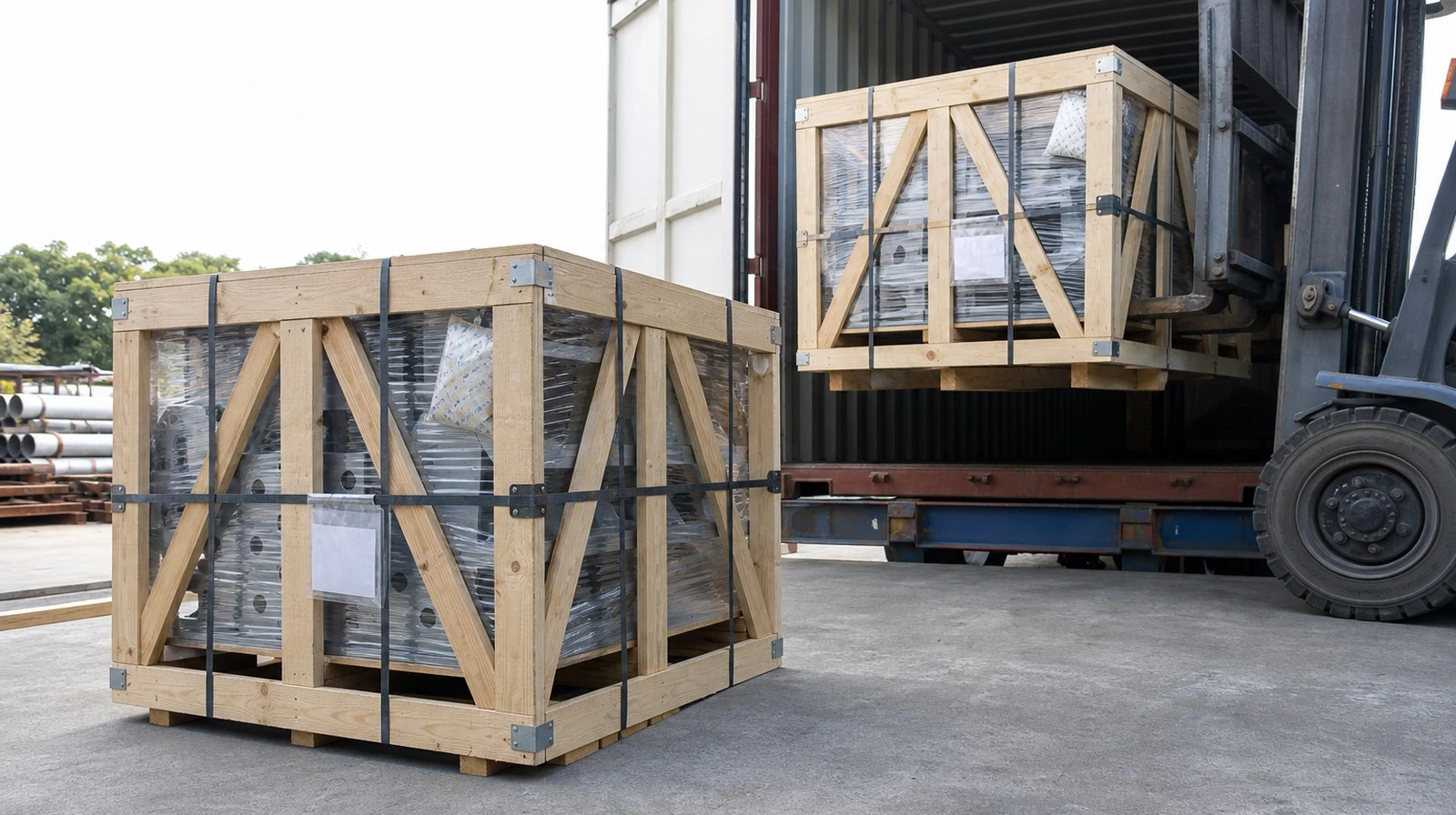
Crate, VCI film, desiccant, tensioned strapping - and a photo taken before the doors close.
Core Takeaways
Start with the corrosion zone map, not the coating note.
Specify material grade, certificate type, and traceability requirements in the BOM.
Reference a qualified welding standard and define inspection scope in the RFQ.
Use zone-specific surface protection; HDG is a strong base layer for carbon steel in marine environments.
Request a sample document package and loading photos before the first batch ships.
Frequently Asked Questions
Which steel grade should I specify for marine and offshore fabrication?
For carbon steel fabrications, S355JR or Q355B are common grades. For severe chloride exposure, 316 or 316L stainless is the usual choice. The certificate type matters as much as the grade: EN 10204 3.1 confirms the mill's own test results and is sufficient for most OEM work, while EN 10204 3.2 adds independent inspection and is often required for classification projects.
What welding standard applies to marine and offshore fabrications?
Reference AWS D1.3, EN 1090, or a local equivalent such as AS/NZS 5131 in the RFQ, backed by ISO 3834 welding quality management. Define the inspection scope at the same time: visual testing of every weld with a weld log is the baseline, and UT or MT should be available through audited partners on request.
How should surface protection be specified for marine steel?
Define the protection system by corrosion zone rather than one global note. Hot-dip galvanizing to ISO 1461, ASTM A123, or AS/NZS 4680 is a proven base layer for atmospheric and splash-zone carbon steel, with a specified coating thickness range and adhesion checked at edges and vent holes. Duplex systems, HDG plus a compatible topcoat, extend life in the most aggressive zones. Require a coating thickness report.
Why do drain holes matter in welded marine structures?
Sealed cavities trap moisture, and salt-laden water that cannot drain becomes the starting point for internal corrosion. Specify drain holes at the lowest point of every cavity, with 10 mm as a practical minimum so salt and debris do not plug them. Lap joints and unstitched weld toes also trap chloride-laden moisture, so require seal welds on hidden backsides.
What documentation should accompany a marine fabrication order?
A weld map with WPS reference, welder ID, and VT record for each weld; heat numbers linked to each part or batch; coating records covering pre-treatment, coating thickness readings, and adhesion test results; and a dimensional report measured against datum for bolted interfaces. Ask for a sample document package with the first article.
Ready to Make Your Offshore Fabrication Specification Bulletproof?
Send us your drawing, material specification, target quantity, and service environment. We will return a DFM report within 48 hours covering corrosion-zone design, welding joints, surface finish options, and cost-saving changes. No commitment required.
Get a free DFM review for your marine or offshore project →
Related reading
Marine and offshore fabrication - frames, skids, platforms, and pipe supports in carbon and stainless steel.
Sheet metal fabrication capabilities - enclosures, brackets, and light-gauge marine parts.
Heavy plate welding services - WPS control and preheat discipline for demanding joints.
Structural steel OEM manufacturing - platforms, skids, and frames.
About the publisher
Qingdao Tianhua Yihe Metal Fabrication is a sheet metal and welded fabrication supplier based in Qingdao, China. We work with OEMs on custom sheet metal parts, medium and heavy plate welding, and structural steel fabrication, with ISO 3834 welding quality management and HDG