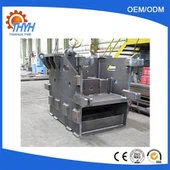
Customer Case Study | August 12, 2026 | Heavy Plate Welding · AS/NZS 4680 HDG · Coastal Infrastructure
Heavy plate welding, sheet metal fabrication, and structural steel OEM
- exported to Australia for 20 years, manufactured to AS/NZS 4680 HDG and AWS D1.1 weld standards.
Most steel bracket rework doesn't actually start at the welding bay or the HDG tank.
It starts with one small assumption that quietly gets carried from the drawing into production
- and only shows up after the parts come back from the galvanizer.
That's the situation an Australian coastal infrastructure OEM walked into our shop with earlier this year.
They'd been sourcing 12 mm heavy plate weldments from two previous suppliers, across 1,200 pieces.
About 12% of every shipment came back with visible distortion after hot-dip galvanizing,
plus another 4–6% with non-conformance reports at receiving. Lead times stretched from a quoted 4 weeks to 7–8 weeks
- three of which were rework loops.
Here's how we got it to zero rework and shipped all 1,200 pieces in 28 days.
"Why does every batch come back from HDG bent?"
- Customer's first message to our engineering team, January 2026

The Project Snapshot
A single bracket isn't complex. A thousand of them is a process.
Product: 12 mm AS/NZS 3678 GR350 welded steel bracket, hot-dip galvanized to AS/NZS 4680
Quantity: 1,200 pieces across 4 weekly batches of 300
Tolerance: ±1.5 mm on critical flatness after HDG (measured across 600 mm span)
End use: Coastal infrastructure, exposed to salt-air wash-down conditions
Pain points inherited from previous suppliers: post-galvanizing distortion + non-conformance at receiving
What the DFM Review Surfaced (Before the First Cut)
We don't quote first. We DFM first.
When we pulled the customer's 3D model alongside the two previous suppliers' rework reports, three patterns jumped out:
Single-sided weld sequence without restraint left residual stress locked into the plate stack-up.
The HDG dip at 450 °C then released the stress - and the bracket distorted.
Generic lifting fixtures for HDG were being reused across multiple part geometries, so the brackets hung on edge instead of dipping flat.
Coating thickness varied from 70 µm on one face to 130 µm on the other, averaging ~100 µm - technically "in spec range," but well outside the customer's flatness tolerance.
WPS was a copy-paste from a thinner-gauge job, with no preheat call-out for the 12 mm GR350 plate. Charpy impact test reports weren't being retained with the batch paperwork.
None of these are exotic problems. They're the same three patterns we see on roughly 60% of the OEM heavy plate fabrication projects that cross our floor - and they're almost always the root cause of hot-dip galvanizing rework.

What We Changed (In Three Concrete Moves)
1.Re-sequenced weld procedure + dedicated clamp fixture. Stitch welding alternating sides with the bracket locked in a purpose-built jig reduces residual stress release by approximately 50% before HDG. Every batch runs on the same fixture - no operator memory, no fixture drift.
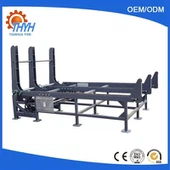
2.Custom HDG hanging rack matched to bracket geometry. Parts dip flat rather than on edge, coating thickness lands within ±10 µm across all five measurement points per AS/NZS 4680 §5.4, and no post-galvanizing straightening is required.
3.New WPS with explicit preheat + Charpy coupon retention. Documented against the actual 12 mm GR350 plate and filler wire combination. Each batch ships with its MTC, WPS, and PQR all keyed to the same heat number.
The Result, in the Numbers That Matter
By batch four, the customer's QA team wasn't issuing any more non-conformance reports.
Rework rate dropped from ~12% to 0% by batch four, sustained across all 1,200 pieces
Lead time locked at 28 days, including the third-party QA hold (previous suppliers averaged 7–8 weeks)
AS/NZS 4680 coating thickness: every batch measured within 85–95 µm (average ~100 µm), full traceability on every heat number
Zero post-galv straightening - the part shape as it leaves the fixtured weld cell is the part shape as it ships
The customer extended the contract to a 12-month rolling schedule, with a second bracket family added to the same manufacturing flow
"We stopped getting NCRs after batch two. By batch four, our QA team was just signing off and moving on."
- Customer QA Manager

What This Means for Your Next OEM Project
Most OEM bracket, mount, or structural assembly projects have similar lever points hiding in plain sight: weld sequence, fixture strategy, galvanizing jig, and the WPS paperwork. None of them show up on a price-quote sheet - but each one can swing your rework rate by double digits.
When OEM customers bring us heavy plate welding jobs that run alongside other sheet metal fabrication or structural steel work in the same shipment, the same lever points apply.
If your drawings are sitting in an inbox waiting for a third or fourth quote, send them to us first. We'll run a free DFM pass focused on exactly these four levers, and tell you honestly whether the project is a good fit before we ever send a price.
Send us your drawings - we'll run a free DFM review and flag every welding, fixturing, and HDG risk before you commit to a production order.
All drawings handled under NDA. Engineering reply within two working days.