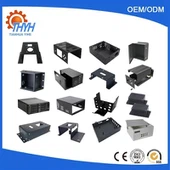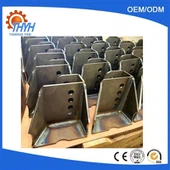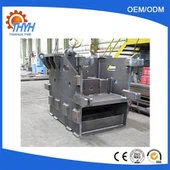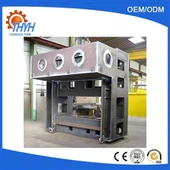
Heavy-duty welded steel base frames are the structural foundation for industrial equipment, machinery, and large-scale infrastructure projects. A well-designed base frame distributes loads efficiently, provides rigid support under dynamic conditions, and maintains dimensional stability throughout its service life. This guide examines the design principles, structural components, and engineering advantages of welded steel base frames-providing B2B buyers and project engineers with the knowledge to evaluate fabrication quality and specify the right solution for their applications.
Core Components of Welded Steel Base Frames
Welded Joints
The welded joint is the contact area where two or more workpieces are permanently joined during the welding process. For heavy-duty base frames, the most common joint configurations include:
Butt joints: Used for connecting plates of similar thickness in the same plane. Full-penetration butt welds provide maximum strength for primary structural members.
T-joints: The most prevalent joint type in box-section frames, connecting vertical members to horizontal base plates. Fillet welds on both sides provide adequate strength for most loading conditions.
Corner joints: Used at frame corners where two members meet at 90°. Proper preparation (beveling) ensures full root penetration.
Selecting the appropriate joint configuration is crucial for ensuring structural strength and leak-tightness. Our engineering team uses finite element analysis (FEA) to verify joint capacity under anticipated loading conditions.
Welds
The weld itself-the solidified molten metal forming the connection-directly determines joint performance. At Tianhua Yihe, our robotic welding systems control heat input (typically 1.5–3.5 kJ/mm for structural welds), travel speed, and wire feed rate to produce consistent, defect-free welds. All critical welds undergo visual inspection, and NDT (ultrasonic or magnetic particle) testing per ISO 17640 requirements.
Fusion Zone and Heat-Affected Zone (HAZ)
Two metallurgical zones deserve attention in heavy-duty welded frames:
Fusion Zone: The transitional region between deposited weld metal and the unaffected base metal. Here, chemical composition and microstructure change significantly. Controlling welding parameters (current, voltage, speed) manages the fusion zone width and properties.
Heat-Affected Zone (HAZ): The base metal region that, while not melted, experiences thermal influence altering its microstructure and mechanical properties. For Q345 steel welded with moderate heat input, the HAZ typically extends 2–5mm from the weld toe. Understanding HAZ behavior is instrumental in predicting fatigue life and brittle fracture resistance.
Design Principles for Heavy-Duty Base Frames
Load Distribution and Stiffener Placement
Effective base frame design ensures that applied loads transfer efficiently to the foundation. Key design elements include:
Base plates: Typically 20mm–50mm thick, sized to distribute concentrated loads and provide bolt-down connection points. Base plate flatness should be within 0.5mm/m² to ensure uniform bearing.
Gusset plates: Triangular stiffeners welded at joint intersections to increase local stiffness and resist bending moments. Gusset thickness is typically 60–80% of the main member thickness.
Internal diaphragms: Transverse plates welded inside box sections to prevent local buckling under compressive loads. Diaphragm spacing is typically 1–1.5 times the section depth.
Welding Sequence and Distortion Control
Welding induces thermal expansion and contraction, causing distortion if not properly managed. Our fabrication procedure includes:
Pre-set distortion compensation (pre-bending members by 1–3mm in the opposite direction of expected distortion)
Balanced welding sequence (alternating sides to balance shrinkage forces)
Stress relief where required (post-weld heat treatment at 550–650°C for thick-section welds)
Final machining of critical surfaces after welding to achieve specified tolerances
Advantages of Welded Fabrication for Large-Scale Steel Frames
Compared to bolted connections and cast alternatives, welded steel base frames offer distinct advantages:
Structural rigidity: Welded joints create monolithic connections that resist dynamic loading and vibration-critical for equipment bases subject to operational forces.
Weight efficiency: Welded construction eliminates the need for heavy connection plates and bolt arrays, reducing total weight by 15–25% versus equivalent bolted designs.
Design flexibility: Welded fabrication accommodates complex geometries, non-standard cross-sections, and site-specific modifications that off-the-shelf sections cannot achieve.
Sealed connections: Continuous welds create weathertight, corrosion-resistant joints-particularly important for outdoor equipment bases in corrosive Australian environments.
Cost-effectiveness: For medium to large production runs, welded fabrication is more economical than casting (no pattern/tooling costs) and faster than complex bolted assembly.
Quality Assurance at Tianhua Yihe
Every heavy-duty base frame produced in our facility undergoes a structured quality process: raw material verification with MTC, first-article dimensional inspection, in-process weld inspection, post-weld NDT on critical joints, final CMM dimensional verification, and surface treatment inspection per AS/NZS 4680 (where applicable). Our ISO 9001:2015 certification ensures that every step is documented and traceable.
Key Takeaways
Heavy-duty base frames rely on properly designed welded joints (butt, T-joint, corner) with full-penetration welds for primary structural members
Gusset plates, internal diaphragms, and properly sized base plates are essential for load distribution and local stiffness
Welding sequence and distortion control techniques (pre-set compensation, balanced sequence) are critical for dimensional accuracy
Welded fabrication offers 15–25% weight savings and superior rigidity versus bolted alternatives
HAZ management through controlled heat input ensures long-term fatigue resistance
Need Heavy-Duty Welded Steel Base Frames?
Our robotic welding cells and ISO 9001 quality system deliver base frames with weld quality you can trust. We manufacture to your drawings with tolerances as tight as ±0.5mm.
Email: andywang@qdthyhmetalfab.com | WhatsApp: +86 138 6398 9651
Get a free fabrication quote | See our welded steel base frame installation guide