Published: September 3, 2026 · Last reviewed: September 3, 2026 · By the engineering team at Qingdao Tianhua Yihe Metal Fabrication

An enclosure spec'd in SS316 for an indoor electrical room. A bracket designed in aluminum because it "felt lighter on the drawing." A galvanized frame replaced with stainless to solve a corrosion problem that a proper coating schedule would have fixed at a quarter of the cost. Material selection mistakes like these rarely show up on the quote - they show up months later, in unit cost drift, field failures, and redesign loops.
After reviewing hundreds of RFQs and drawings from OEM buyers across different markets, our engineering team at Qingdao Tianhua Yihe Metal Fabrication (qdthyhmetalfab.com) has seen material mismatch account for a large share of avoidable cost in custom fabrication - not tolerances, not welding, but simply specifying the wrong alloy for the environment, load, and finishing plan.
Reader's Checklist
| Item | Minimum to Specify | Why It Matters |
|---|---|---|
| Service environment | Indoor / outdoor / coastal / chemical exposure | Drives corrosion strategy and alloy choice |
| Load requirement | Static, dynamic, or impact; approximate magnitude | Determines whether strength-to-weight matters |
| Weight sensitivity | Critical / moderate / not a concern | The main justification for aluminum |
| Corrosion protection | HDG, powder coat, paint, or inherent alloy resistance | Often cheaper than upgrading the alloy |
| Welding requirement | Welded assembly or mechanical fastening | Affects alloy selection and filler strategy |
| Certification needs | EN 10204 3.1 material certificates, ISO 3834 welding quality | Verification your market expects |
The Three Materials at a Glance
Carbon Steel (Q235B / Q355B, ASTM A36, S275JR)
Carbon steel is the default workhorse of structural fabrication. It offers high strength at low cost, excellent weldability under AWS D1.1 or equivalent procedures, and full compatibility with hot-dip galvanizing. Its one weakness - corrosion - is fully manageable with the right finishing plan.
Best suited for: Structural frames, equipment bases, pipe racks, welded assemblies
Key advantage: Strength-to-cost ratio; proven welding behavior
Trade-off: Requires a protection strategy - bare carbon steel is not an option outdoors
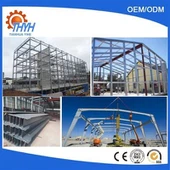
For outdoor structural work, hot-dip galvanizing under standards such as ISO 1461 (your local equivalent might be AS/NZS 4680) gives decades of maintenance-free corrosion protection at modest cost. Our structural steel fabrication service runs on this combination daily.
Stainless Steel (304 / 316)
Stainless steel resists corrosion through its chromium oxide layer - no coating needed. SS304 handles most general environments; SS316 adds molybdenum for chloride-rich settings such as coastal sites and chemical contact. The trade-offs are higher material cost, more careful welding, and sensitivity to contamination during fabrication.
Best suited for: Food and hygiene equipment, chemical exposure, marine-adjacent components, visible architectural parts
Key advantage: Inherent corrosion resistance - no coating to scratch off
Trade-off: Roughly 3–5× the material cost of carbon steel; welding requires heat control to avoid distortion and heat tint
One practical note: welding quality systems under ISO 3834 matter more with stainless, because discoloration and distortion are process-controlled outcomes, not material properties. Better approach than defaulting to stainless: confirm the environment actually attacks carbon steel's coating first.
Aluminum (5052 / 6061-T6)
Aluminum weighs about a third of steel per volume and forms a natural oxide layer that protects it in most atmospheric conditions. The 5xxx series (5052) welds and forms well for sheet work; 6061-T6 is favored for machined and structural parts but loses strength in the weld heat-affected zone.
Best suited for: Weight-sensitive panels, brackets, covers, enclosures where handling weight matters
Key advantage: Strength-to-weight ratio; corrosion resistance without coating; anodizing options for finish and wear
Trade-off: Lower stiffness (deflection governs many designs), softer surfaces, and welding needs the right filler (5356 or 4043) plus distortion management
Aluminum sheet work is a natural fit for laser-based sheet metal fabrication, where clean edges and controlled heat input preserve flatness on thin gauges.
Side-by-Side Comparison

| Factor | Carbon Steel | Stainless Steel | Aluminum |
|---|---|---|---|
| Relative material cost | Low | High | Medium |
| Strength | High | High | Moderate |
| Weight | High | High | Low (~1/3 of steel) |
| Corrosion resistance | Needs coating | Inherent | Inherent (oxide layer) |
| Weldability | Excellent | Good (heat control needed) | Good (filler + distortion control) |
| Formability | Good | Good (work hardens) | Very good (annealed tempers) |
| Finishing options | HDG, powder coat, liquid paint | Passivation, pickle, polish | Anodizing, powder coat, liquid paint |
| Typical use | Structures, bases, frames | Hygiene, chemical, coastal | Panels, brackets, weight-critical parts |
When to Choose Each - and What to Ask Instead

Choose carbon steel when strength and cost govern the design and the environment can be handled by coating. Most equipment bases, mezzanine components, and heavy weldments belong here - our heavy plate welding service processes carbon steel plate under an ISO 3834 quality system, with galvanized finishing supported for outdoor duty.
Choose stainless when the environment attacks coatings - chloride exposure, chemical contact, or hygiene-cleaning regimes - or when the part must stay coating-free by regulation.
Choose aluminum when weight reduction pays for itself: handling ergonomics, transport weight limits, or vibration-sensitive assemblies.
A few patterns worth flagging before you finalize a spec:
Galvanic corrosion is real: direct contact between aluminum and bare steel (or stainless) in a wet environment creates a corrosion cell at the joint. Isolate with coatings, washers, or design.
Upgrading the alloy is not always the fix: a well-executed HDG schedule on Q235B frequently outperforms a marginally specified stainless grade at lower total cost. Ask your fabricator for a finishing-based alternative before committing.
Welding changes the material: 6061-T6 drops to roughly half strength in the weld zone, and stainless distortion is a process variable. Specify performance required at the joint, not just the parent metal.
Documentation travels with the part: for markets that verify, EN 10204 3.1 material certificates and a documented welding quality system (ISO 3834) are baseline expectations, not extras.
Core Takeaways
Match material to environment and load first - cost and finishing follow from that decision, not the reverse.
Carbon steel + HDG covers most outdoor structural work at a fraction of stainless cost; specify coating standards, not just "galvanized."
Stainless pays for itself only in coating-hostile environments (chlorides, chemicals, hygiene regimes); weld heat control determines the outcome.
Aluminum buys weight savings, not stiffness - deflection-limited designs may need thicker sections that erase the cost advantage.
Ask your supplier for alternatives in writing: a fabricator who pushes back with a cheaper material-plus-finishing route is doing engineering, not upselling.
Material Selection FAQ
Is stainless steel worth the extra cost over carbon steel?
Only when the service environment attacks coatings - chloride exposure, chemical contact, or hygiene-cleaning regimes - or when the part must stay coating-free by regulation. Stainless runs roughly 3–5× the material cost of carbon steel, and a well-executed hot-dip galvanizing schedule on Q235B frequently outperforms a marginally specified stainless grade at lower total cost.
Which is better for outdoor structures: galvanized carbon steel or stainless steel?
For most outdoor structural work, carbon steel with hot-dip galvanizing under ISO 1461 (or AS/NZS 4680 in Australia) gives decades of maintenance-free protection at a fraction of stainless cost. Choose stainless (SS316 for coastal chloride exposure) only when the environment defeats coatings or coating-free construction is required.
Can 6061-T6 aluminum be welded without losing strength?
6061-T6 is weldable, but it drops to roughly half strength in the weld heat-affected zone. Specify the performance required at the joint rather than the parent metal, use the correct filler (5356 or 4043), and plan distortion management - for thin gauges, laser-based sheet metal fabrication with controlled heat input helps preserve flatness.
What material certificates should buyers request from a fabrication supplier?
For markets that verify, EN 10204 3.1 material certificates and a documented welding quality system under ISO 3834 are baseline expectations, not extras. Ask for the certificate register and welding quality documentation before you sign the PO.
Get a Second Opinion on Your Material Spec
Send us your drawing, material specification, and target quantity. We will return a DFM report within 48 hours covering tolerance feasibility, welding joint recommendations, surface finish options, and potential cost-saving changes - including whether a different material or finishing route would do the same job for less. No commitment required.
About the Publisher
Qingdao Tianhua Yihe Metal Fabrication - Qingdao, China
Core capabilities: sheet metal parts, medium and heavy plate welding, structural steel fabrication.
Supported by an ISO 3834 welding quality management system and hot-dip galvanized finishing.