Published: September 4, 2026 · Last reviewed: September 4, 2026 · By the engineering team at Qingdao Tianhua Yihe Metal Fabrication
An "as-machined" finish that's actually covered in mill scale and storage stains. A spec calling for "galvanized" without a reference standard - so the first batch returns with light zinc coverage that fails visual inspection on day one. A "powder-coated" enclosure with no surface prep documented, and the coating starts flaking six months after delivery. Finish specification errors rarely cost the quote - they cost the relationship.
After reviewing hundreds of RFQs and drawings from OEM buyers across different markets, our engineering team at Qingdao Tianhua Yihe Metal Fabrication (qdthyhmetalfab.com) has seen finish-spec gaps cause more rework than any other category - tolerances get reviewed, but finish instructions often travel from procurement to shop floor with less clarity than the rest of the drawing.
Reader's Checklist
| Item | Minimum to Specify | Why It Matters |
|---|---|---|
| Service environment | Indoor / outdoor / coastal / chemical / hygiene | Drives finish selection and durability expectation |
| Corrosion strategy | Inherent alloy, coating, or both | Prevents over-spec on alloy and under-spec on coating |
| Reference standard | ISO 1461, AS/NZS 4680, ASTM A123, etc. | Removes ambiguity from "galvanized" |
| Surface prep required | Blast, pickle, passivate, degrease | Determines whether the finish will actually adhere |
| Appearance grade | Visual / industrial / premium | Aligns expectation between buyer and shop |
| Color / texture | RAL number, gloss level, texture spec | Avoids "any black will do" mismatches |
| Documentation | Inspection certs, salt-spray hours, film thickness | The evidence you'll need if the finish fails |
The Main Finish Families
Surface finishing is rarely one process. It's a chain: substrate prep → primary protection → optional secondary coating → cosmetic finish → documentation. Each link has multiple options, and most of the rework we see comes from skipping a link or specifying it loosely.
Hot-Dip Galvanizing (HDG)
Hot-dip galvanizing dips fabricated steel into molten zinc, producing a metallurgical bond that resists abrasion and corrosion. For structural carbon steel parts used outdoors, HDG remains the most cost-effective long-term protection - decades of service life, no repainting cycle.
Reference standards: ISO 1461 (international), AS/NZS 4680 (Australia/NZ), ASTM A123 (USA)
Best suited for: Structural sections, plate weldments, equipment bases, outdoor enclosures, handrails, brackets
Key advantages: Long maintenance-free life, full coverage including internal cavities, sacrificial protection at cut edges
Trade-offs: Dimensional change at threaded areas, surface texture is matte and slightly rough, not suited to tight-tolerance cosmetic surfaces
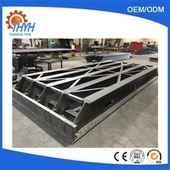
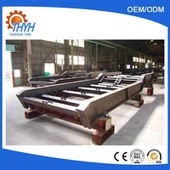
Our structural steel fabrication service runs HDG under AS/NZS 4680 as a baseline finish for outdoor work. One practical note: HDG performs best when the base steel has a consistent chemistry. Silicon levels in the steel influence coating thickness, so for predictable results specify the steel grade alongside the finish standard.
Powder Coating
Powder coating applies electrostatically charged dry powder that is then heat-cured into a uniform film. It offers a wide color range, decent UV resistance, and a more cosmetic appearance than HDG.
Reference standards: ISO 8503 (surface prep), Qualicoat / GSB (architectural-grade certification)
Best suited for: Equipment enclosures, visible architectural parts, panels where color matching matters
Key advantages: Wide RAL color range, smooth cosmetic finish, good UV stability with proper chemistry
Trade-offs: Requires proper prep (blast or phosphate), will not survive a hammer blow like HDG, and film thickness control depends on the line

Powder coating over HDG (a duplex system) gives both sacrificial and barrier protection - common on architectural and high-visibility parts. The catch: the HDG surface must be prepared correctly before powder application, or the bond fails.
Liquid Paint (Wet Coat)
Liquid paint remains widely used, especially for very large parts, on-site touch-ups, and parts with mixed materials. Modern industrial coatings approach powder in performance when properly applied.
Reference standards: ISO 12944 (corrosion protection classes), SSPC / NACE surface prep standards
Best suited for: Large weldments that won't fit a powder line, field repair situations, parts with masking requirements
Key advantages: No oven size limit, flexible masking, accessible touch-up
Trade-offs: VOC compliance, longer cure cycles, more operator skill-dependent
Anodizing (Aluminum Only)
Anodizing grows a controlled oxide layer on aluminum - it's not a coating in the traditional sense. The result is integral to the substrate, hard, and can be dyed.
Reference standards: ISO 7599 (anodic coating classification), MIL-A-8625 (Type II / Type III hardcoat)
Best suited for: Aluminum panels, brackets, visible components where wear or color stability matters
Key advantages: Integral to the substrate (cannot chip off), excellent hardness in hardcoat variants, color options
Trade-offs: Aluminum substrate only, smaller parts typically, color variation between batches is common
Our sheet metal fabrication service integrates anodizing for aluminum parts where lightweight and cosmetic finish both matter.
Plating, Passivation, and Other Specialty Finishes
For stainless steel, passivation (commonly per ASTM A967) restores the chromium oxide layer disrupted during welding and fabrication. Electropolishing goes further, smoothing the surface for hygiene-critical applications.
For carbon steel in mild environments, black oxide or phosphate coatings offer temporary corrosion resistance with clean appearance - frequently used as a base for subsequent oil or paint.
Each of these sits in a narrow application window and should be specified when the part genuinely needs it, not as a default.
Side-by-Side Comparison

| Finish | Substrate | Reference Standards | Durability | Appearance | Cost Driver |
|---|---|---|---|---|---|
| HDG | Carbon steel | ISO 1461, AS/NZS 4680, ASTM A123 | Decades (sacrificial) | Matte, spangled | Bath size, steel weight |
| Powder coat | Steel / aluminum | ISO 8503, Qualicoat | Years (barrier) | Wide RAL, smooth | Oven size, prep method |
| Liquid paint | Steel / aluminum | ISO 12944, SSPC | Years (depends on system) | Variable | Labor, masking |
| Anodizing | Aluminum only | ISO 7599, MIL-A-8625 | Permanent | Limited colors | Tank size, alloy |
| Passivation | Stainless steel | ASTM A967, ISO 16048 | Permanent | Unchanged | Process time |
| Phosphate / black oxide | Carbon steel | MIL-DTL-16232, TT-C-490 | Months (oil-treat to extend) | Industrial dark | Low |
When to Choose Each - and What to Ask Instead
Choose HDG when the part lives outdoors, gets handled roughly, or needs decades of maintenance-free life. Specify the standard (ISO 1461 or AS/NZS 4680), the steel grade, and any post-galvanizing requirements.
Choose powder coat when color matching and cosmetic appearance matter, and the part can fit an oven. Specify RAL number, gloss range, surface prep grade, and film thickness.
Choose liquid paint when the part is too large for powder lines or requires field-repairable coatings.
Choose anodizing for aluminum when you want finish integral to the substrate - chips can't lift powder off hard anodized surfaces the way they might on a coated part.
Choose passivation for stainless after welding, particularly for hygiene, food-contact, or chemical-exposure parts.
A few patterns worth flagging before you finalize a finish spec:
"Galvanized" is not a finish spec: without a reference standard and steel grade, results vary widely. Better approach than leaving it open: specify the standard (ISO 1461 / AS/NZS 4680) and the post-galvanize treatment.
Surface prep is part of the finish: powder over unblasted steel fails. Specify prep grade alongside the coating. For weldments going to HDG, our heavy plate welding service sequences welding before galvanizing to keep prep minimal and consistent.
Duplex systems need sequencing: HDG plus powder is a real engineering combination, but the sequence and surface prep between steps must be specified. "Duplex HDG + powder to RAL 7035" is a spec. "Galvanize and paint" is not.
Documentation travels with the finish: film thickness logs, salt-spray test reports, galvanizing certificates - these are what your customer or inspector will ask for, and they need to be on the supplier's quote from day one.
Core Takeaways
Specify the reference standard, not just the finish name - "galvanized per AS/NZS 4680" is a spec; "galvanized" is a hope.
Surface prep is part of the finish, not a separate decision - link prep grade to coating type in the drawing notes.
HDG dominates outdoor structural duty because of its sacrificial and full-coverage behavior - most "stainless would be better" calls become unnecessary once HDG is properly specified.
Powder coat and liquid paint fill the cosmetic and large-part gaps that HDG cannot - they require prep, cure time, and masking discipline.
For aluminum, anodizing gives an integral finish that cannot chip like a coating can - when substrate and finish are the same material, durability changes.
Ask for certificates, film thickness records, and salt-spray data in writing - finishes are the most visible failure mode and the easiest to document against.
Surface Finish FAQ
What is the difference between hot-dip galvanizing and powder coating?
HDG is a sacrificial, metallurgically bonded zinc coating: it protects cut edges and internal cavities, lasts for decades outdoors, but has a matte, slightly rough texture. Powder coating is a barrier film that offers a wide RAL color range and a smooth cosmetic finish, but it needs proper surface prep and an oven, and it will not survive a hard impact the way HDG does. The two can be combined as a duplex system for architectural parts.
Which surface finish is best for outdoor steel parts?
For structural carbon steel used outdoors, hot-dip galvanizing remains the most cost-effective long-term protection - decades of service life with no repainting cycle. Specify the reference standard (ISO 1461, AS/NZS 4680 or ASTM A123), the steel grade, and any post-galvanizing treatment. For high-visibility architectural parts, a duplex system (HDG plus powder coat) adds color and barrier protection.
Can powder coating be applied over galvanized steel?
Yes - that combination is a duplex system giving both sacrificial (zinc) and barrier (powder) protection. The catch is sequencing and surface prep: the HDG surface must be blasted or otherwise prepared correctly before powder application, or the bond fails. "Duplex HDG + powder to RAL 7035" is a complete spec; "galvanize and paint" is not.
What is passivation and when does stainless steel need it?
Passivation (commonly per ASTM A967) restores the chromium oxide layer on stainless steel that welding and fabrication disrupt. It is needed after welding, particularly for hygiene, food-contact, or chemical-exposure parts. Electropolishing goes a step further, smoothing the surface for the most demanding applications.
Get a Free Review of Your Finish Spec
Send us your drawings and target service environment. We will return a finish recommendation within 48 hours - including the reference standard, prep grade, and any sequencing issues that could cost you rework. No commitment required.
About the Publisher
Qingdao Tianhua Yihe Metal Fabrication (qdthyhmetalfab.com) is an OEM metal fabrication supplier based in Qingdao, China. Core capabilities include sheet metal parts, medium and heavy plate welding, and structural steel fabrication - supported by an ISO 3834 welding quality management system and hot-dip galvanized finishing.