





Hot-Dip Galvanized Steel Crane Runway Beam with Welded Bracket & Bolted End Plate for Overhead Gantry Crane Support Systems
Target Keywords
steel crane runway beam, galvanized crane beam, gantry crane girder, overhead crane support beam, crane rail beam, welded bracket crane beam, bolted crane runway, industrial crane girder, HDG crane beam, crane runway fabrication, gusset plate crane beam, Q355B crane girder, heavy duty crane beam, steel structure crane fabrication
Brief Description
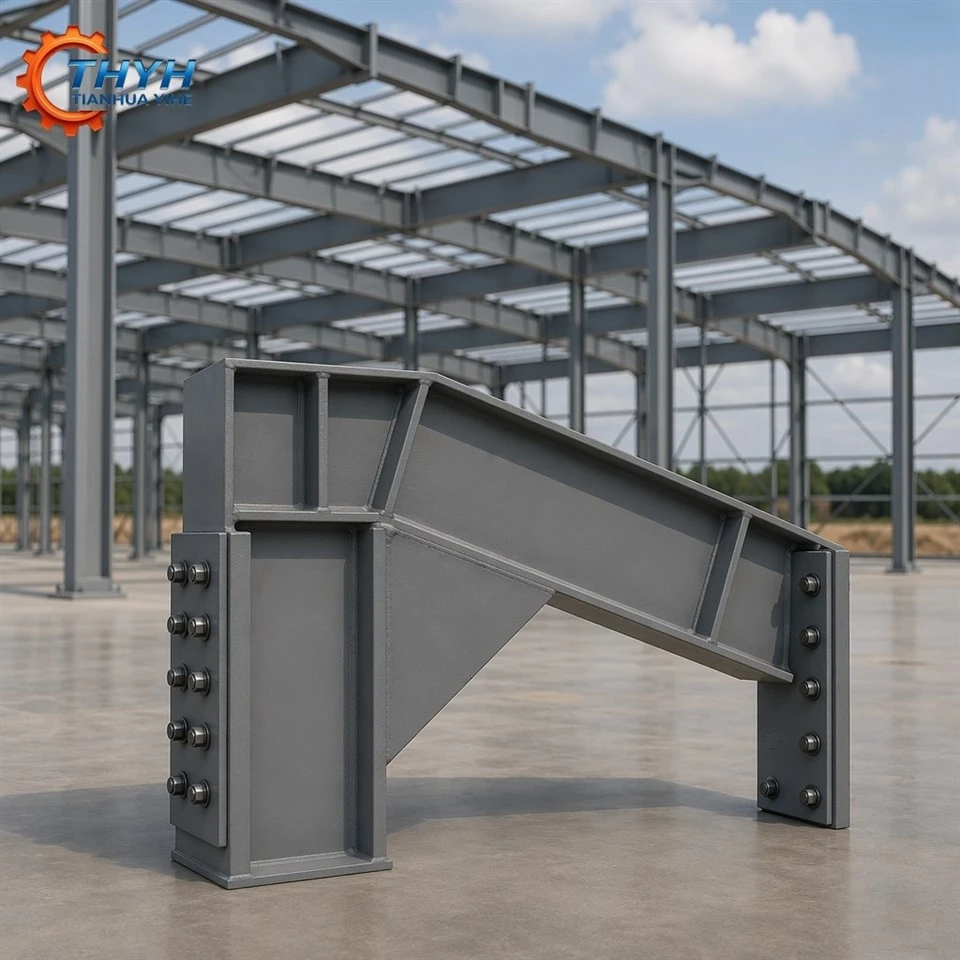
Heavy-duty hot-dip galvanized crane runway beam assembly with bolted end plate, welded side gusset brackets, and 8-bolt connections. Engineered for overhead gantry crane support in steel mills, heavy fabrication shops, and industrial warehouses.
Detailed Description
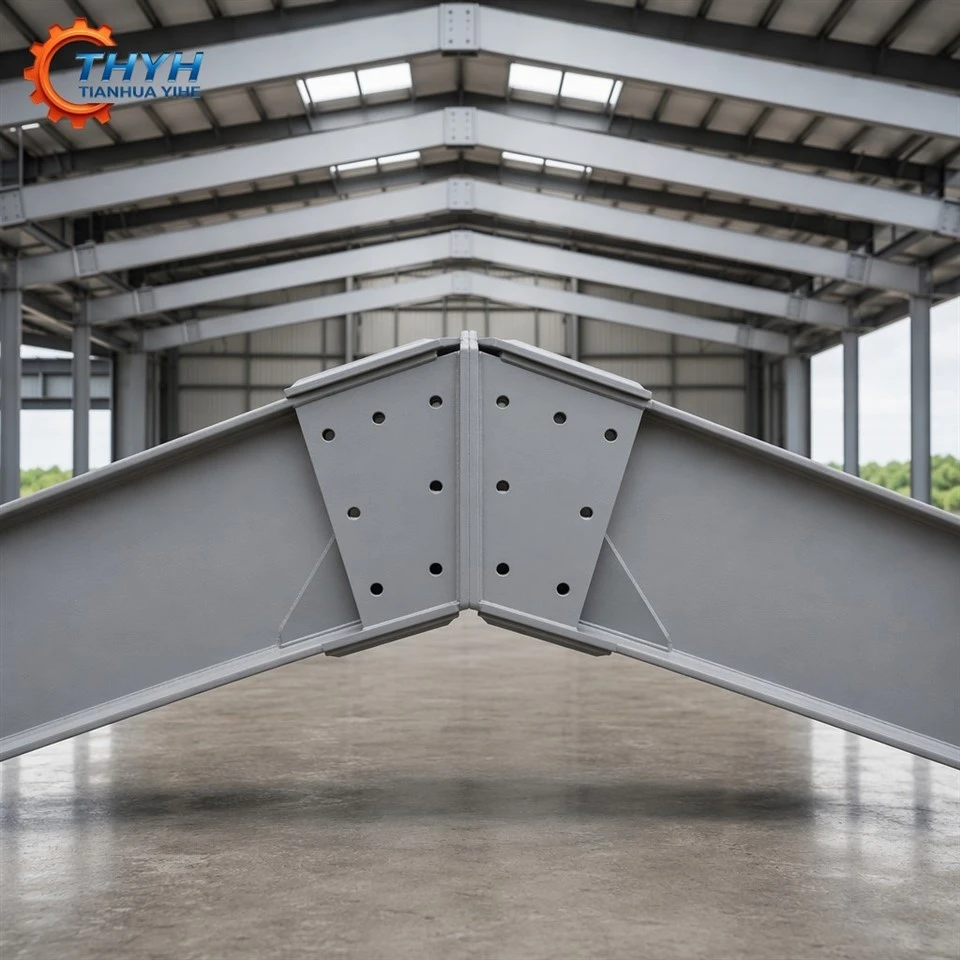
This galvanized crane runway beam (crane girder) is the horizontal support member on which an overhead gantry crane travels - carrying the combined weight of the crane bridge, hoist, trolley, and lifted load. Unlike a standard building beam designed for static gravity loads, a crane runway beam must resist repeated cyclic loading from crane passes (fatigue), lateral forces from crane acceleration and braking, and impact loads from load pickup and release. The beam shown is a built-up welded section (or two I-beams joined side-by-side) with a thick bolted end plate at the front face, featuring 8 high-strength hexagonal bolts (2×4 pattern) connecting to the supporting column bracket. A triangular gusset plate is welded to the side of the beam near the end, providing additional shear capacity and serving as a connection point. Additional gussets are visible along the beam length, positioned at regular intervals to stiffen the web against concentrated wheel loads from the crane end truck. The complete assembly is hot-dip galvanized to ISO 1461 (70-100μm), providing maintenance-free corrosion protection in the industrial environments where cranes typically operate. Crane runway beams are fabricated from Q355B or Q390B steel for their higher yield strength and fatigue resistance. We design each runway beam per AISC 360, AISC Design Guide 7 (Industrial Buildings), or Eurocode 3 Part 6 (Crane Supporting Structures), including fatigue life calculation for the specified crane service class (CMAA Class A through F). Every runway beam undergoes full weld UT inspection, dimensional verification, and camber/straightness check before delivery. Beams are shipped with rail mounting hardware, bolted splice kits for joining runway segments, and crane rail alignment tolerances clearly specified in the erection manual.
Product Attributes
|
Product Name |
Crane Runway Beam with Bracket & Bolted End Plate |
|
Material Grade |
Q355B / Q390B / S355JR / ASTM A572 Gr.50 |
|
Beam Construction |
Welded built-up plate girder or paired I-beam assembly |
|
End Plate Connection |
Bolted end plate, 8 holes (2×4 pattern), M24-M36 Grade 8.8/10.9 |
|
Side Gussets |
Triangular gusset plates, full-penetration welded for shear reinforcement |
|
Surface Treatment |
Hot-dip galvanized to ISO 1461 (70-100μm average) |
|
Welding |
SAW for flange-web T-joints; full pen. for gussets; 100% UT + MT |
|
Crane Class |
CMAA Class A-F (light service to continuous severe service) |
|
Fatigue Design |
Per AISC 360 Appendix 3 or EC3 Part 1-9; fatigue life >2M cycles |
|
Beam Length |
Segments 6-15m; bolted or welded field splices for longer runways |
|
Span Capacity |
Single beam up to 15m between supports; crane capacity 5-100+ tons |
|
Certification |
ISO 9001:2015, EN 1090-2 EXC3, AWS D1.1, CE marking |
Product Selling Points
Fatigue-qualified details: Welded attachments (gussets, stiffeners, rail clips) are detailed with smooth profile transitions, ground weld toes, and no transverse welds on tension flanges - all per AISC 360 Appendix 3 fatigue categories
Crane rail alignment critical: Our beams are fabricated with camber tolerance of L/1000 maximum and sweep tolerance of L/1000 maximum - tighter than standard building beam tolerances - because the crane rail alignment directly affects crane wheel wear and hoist trolley tracking
Bolted runway splices: Runway beam segments are joined with bolted flange and web splice plates - no field welding of the runway means no post-splice rail re-alignment due to weld distortion
End stop impact design: We integrate the crane end stop (buffer stop) connection into the beam end detail, with the stop bracket bolted to the top flange and reinforced with a welded shear block - tested for the crane's full-speed impact energy
Complete documentation package: Every crane beam ships with mill certificates, weld maps with NDT traceability, fatigue design calculation summary, and a rail alignment tolerance checklist for the site engineer's sign-off
Company Advantages
Crane beam specialization: Our dedicated crane runway production team has delivered beams for 5-100+ ton overhead cranes across steel mills, shipyards, and heavy fabrication shops worldwide
Fatigue engineering: Every crane beam design includes a fatigue life assessment per the specified crane service class - we don't just size for strength, we verify the detail categories at welded attachments meet the endurance requirements
Galvanized with care: Crane beams are galvanized after complete fabrication; our 12.5m bath handles beam segments in single dips, and we control cooling rate to maintain the ±L/1000 straightness required for crane rail alignment
Complete runway package: We supply beams, rail (with clips and pads), end stops, column brackets, and longitudinal tie-backs - the entire runway system from one source
Laser alignment verification: Every beam is checked for sweep (horizontal straightness) and camber (vertical straightness) with a laser tracker - critical because the crane rail tolerance is typically ±2mm in 10m
Frequently Asked Questions (FAQ)
Q1: What crane service class (CMAA) do your runway beams support?
A: We design and fabricate runway beams for all CMAA classes: Class A (standby/infrequent) through Class F (continuous severe service). The service class determines the fatigue design requirements - Class C and above require fatigue life calculations with specific load spectra and cumulative damage assessment per AISC 360 Appendix 3. We'll ask for your crane service class and load spectrum during the inquiry stage.
Q2: How do you ensure the top flange is straight enough for crane rail mounting?
A: The crane rail requires straightness of ±2mm in any 2m length (per CMAA 70). We achieve this through: (1) controlled cooling after welding and galvanizing to minimize distortion, (2) laser tracker measurement of sweep and camber on every beam, (3) flame straightening of any deviation >L/1500 before final inspection. We provide the straightness measurement report with every beam.
Q3: Can you supply the crane rail and mounting hardware as well?
A: Yes. We can supply the complete rail system: crane rail sections (A-series per DIN 536 or JIS equivalents), rail pads (rubber or polyurethane), bolted rail clips, and rail splice bars. The rail is either loose-shipped for site installation or pre-mounted and aligned on the beam in our shop (for shorter beams that can be transported complete). Shop pre-mounting eliminates rail alignment work on site.
Q4: What is the difference between a crane runway beam and a regular building beam?
A: Crane runway beams differ from regular building beams in four critical ways: (1) Fatigue - repeated crane passes require fatigue-qualified weld details; a standard beam's welds may crack under cyclic loading. (2) Lateral loads - crane surge and skew produce horizontal forces that standard beams aren't designed for. (3) Stiffness - vertical deflection limits are tighter (L/600 to L/1000 vs L/240 for floors) to prevent crane trolley drift. (4) Torsion - the eccentric rail load twists the beam; runway beams need adequate torsional stiffness or a lateral restraint system. Our crane beams address all four aspects.
Hot Tags: hot-dip galvanized steel crane runway beam with welded bracket & bolted end plate for overhead gantry crane support systems, China hot-dip galvanized steel crane runway beam with welded bracket & bolted end plate for overhead gantry crane support systems manufacturers, suppliers, factory


