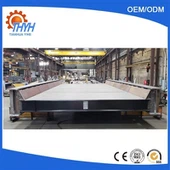
When an OEM needs a batch of welded frames, the first call usually goes to a familiar place - the machine shop twenty minutes from the plant that has rescued more than one breakdown. For a dozen brackets, that call is often the right one. For three hundred a month, with material certificates and a weld log attached, the same call can get expensive. Neither outcome reflects on the shop's skill; it reflects what each type of supplier is built to do.
After reviewing hundreds of RFQs for brackets, frames, enclosures, and welded assemblies from OEM buyers across different markets, our engineering team at Qingdao Tianhua Yihe Metal Fabrication (qdthyhmetalfab.com) has seen five decision factors that separate orders that fit a local machine shop from orders that fit a fabrication factory.
Reader's Checklist
| Item | What to check | Why it matters |
|---|---|---|
| Batch size & cadence | Annual volume and reorder pattern | The supplier type that wins at 10 pieces rarely wins at 500 |
| Total landed cost | Unit price + freight + duties + receiving labor | The local quote is not the only number to compare |
| Documentation scope | WPS, EN 10204 3.1 mill certs, weld logs, dimensional reports | Audited products need records, not reassurance |
| Schedule risk | Ocean transit time vs. production control | Buffer the leg you cannot control |
| Finishing scope | HDG, powder, or paint in-house or outsourced | Every extra handoff adds cost and lead time |
| Engineering contact | One named technical contact | Determines problem-solving speed |
1. Two Different Tools, Not Two Quality Levels
A local machine shop and a fabrication factory are not better and worse versions of each other. They are different tools.
Machine shops shine at speed and proximity. Urgent spares, one-off brackets, design iterations you want to discuss standing at the machine, and quantities too small to justify freight.
Fabrication factories are built for repeat production. Laser cutting, press braking, welding, and finishing under one roof, with process files that let the fifth batch run the same way as the first.
The common mistake is substitution. Treating one supplier type as a drop-in replacement for the other, instead of matching the order profile to the tool.
2. Cost Structure: Unit Price vs. Total Landed Cost
Comparing a local shop's quote to a factory's quote line by line misleads in both directions.
The shop re-prices setup. Small batches fit, but fixturing and machine time stay in every quote as volume grows.
The factory amortizes. Material bought by the sheet, parts nested across orders, and dedicated production lines pull unit price down as volume rises.
Freight is real. Ocean freight, duties, and inland legs belong in the comparison. Heavy, dense parts absorb transport cost far better than light, bulky ones.
Find the crossover. Below a certain quantity, freight and handling dominate; above it, per-piece savings dominate. Where that line sits depends on part size, weight, and value density.
Better approach: Build a two-column landed-cost model - local unit price versus factory unit price plus freight, duty, and receiving labor - before deciding anything.

3. Batch Size and MOQ Economics
Five parts is shop territory. A factory's engineering and setup overhead can exceed the part price at that volume.
Five hundred a quarter is factory territory. The economics of nesting, material scale, and process-file reuse compound with repetition.
Ask about first orders. Many factories accept a small pilot order; what matters is how pricing behaves at your repeat volume, not at the sample.
4. Lead Time: Transport Versus Schedule Depth
The local advantage is the truck, not the calendar. A two-hour drive beats an ocean leg on any single shipment.
The factory advantage is schedule depth. Material release, cutting, welding, finishing, and loading are planned in sequence, with milestone updates - material released, cut, welded, finished, loaded - replacing guesswork.
Buffer what you cannot control. Transit time is fixed; production transparency is not. Judge a factory by how early you hear about a problem, not only by the promised date.
5. Documentation and Quality System Depth
For parts that go into an audited product, records are part of the deliverable.
Welding records. A qualified WPS, welder qualification references, and a weld log with a visual inspection record for every weld; UT/MT through qualified testing partners when specified.
Material traceability. EN 10204 3.1 mill certificates with heat numbers tied to the parts.
Coating records. Hot-dip galvanizing per ISO 1461, ASTM A123, or AS/NZS 4680, with thickness reports.
System standards. Certified ISO 9001:2015 quality management system; structural welding executed to AWS D1.1, AWS D1.3, or EN 1090 standards.
Local shops can supply most of this. The useful question is which documents are standard practice versus an exception that carries fees and delay. See how a documented heavy plate welding process runs from WPS to final inspection.

6. A Decision Framework That Avoids Regret
| Dimension | Local machine shop fits when | Fabrication factory fits when |
|---|---|---|
| Batch size | One to tens of pieces, irregular reorders | Hundreds per run, repeating |
| Urgency | Breakdown-driven, days matter | Planned programs, weeks acceptable |
| Documentation | Invoice and verbal confirmation acceptable | Certs, weld logs, reports required |
| Finishing | Raw parts or simple paint | HDG and batch finishing needed |
| Engineering | Face-to-face iteration | DFM review and revision discipline |
| Transport | Road freight practical | Landed cost amortizes the ocean leg |
The hybrid path is normal. Prototype locally, iterate fast, then move the stable design into batch sheet metal production - the same path many OEMs use for galvanized frames and platforms. The handoff works when the drawing package is complete: GD&T, weld symbols, and a finish spec, because a complete package protects both suppliers.

Core Takeaways
Match the supplier type to the order profile, not to slogans.
Compare total landed cost, not unit price.
Ask what documentation is standard versus an exception - before switching.
Prototype locally, produce at scale; complete drawings make the hybrid work.
Judge factories by milestone transparency, not only by promised dates.
Frequently Asked Questions
When should an OEM choose a local machine shop over an offshore factory?
A local machine shop is ideal for emergency breakdown replacements, low-volume prototypes (1 to 10 pieces), and highly iterative designs requiring rapid face-to-face adjustments where ocean transit times and international freight overhead cannot be amortized.
What is the volume crossover point where overseas fabrication becomes cost-effective?
For medium and heavy welded frames or sheet metal assemblies, the landed cost crossover point typically occurs around 30 to 50 pieces per batch or recurring quarterly orders, where raw material volume purchasing, laser nesting efficiency, and automated finishing offset ocean shipping and tariffs.
How do Chinese fabrication factories ensure drawing compliance and material traceability?
Established ISO 9001:2015 certified factories provide comprehensive documentation chains: raw material Mill Test Certificates (MTC to EN 10204 3.1) traceable to heat numbers, qualified WPS and welder qualification records under AWS D1.1, dimensional inspection reports, and coating thickness certificates.
What is the hybrid sourcing strategy used by successful OEMs?
Under the hybrid sourcing model, OEMs prototype and refine early design iterations with a local shop. Once the drawing, GD&T, and welding specs are frozen, volume repeat production is handed off to an overseas fabrication factory to achieve 30% to 50% landed cost savings.
Ready to Decide With Numbers Instead of Slogans?
If your project needs batch production plus a complete documentation chain, we can help. Send us your drawing, material specification, and target quantity. We will return a DFM report within 48 hours covering tolerance feasibility, welding joint recommendations, surface finish options, and potential cost-saving changes. No commitment required.
Get a free DFM review for your OEM parts →
Related reading
Sheet metal fabrication capabilities - enclosures, brackets, and batch production.
Heavy plate welding services - WPS control and full weld documentation.
Structural steel OEM manufacturing - frames, platforms, and HDG finishing.
Qingdao Tianhua Yihe Metal Fabrication (qdthyhmetalfab.com) is an ISO 9001:2015 certified OEM manufacturer based in Qingdao, China. We work with OEMs on custom sheet metal parts, medium and heavy plate welding, and structural steel fabrication, delivering hot-dip galvanized components fully compliant with ISO 1461, ASTM A123, and AS/NZS 4680 standards.