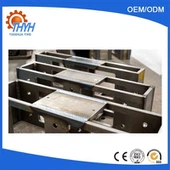
A buyer on an export project once flagged a batch of galvanized brackets as out of spec. The drawing called for HDG to ISO 1461. Incoming inspection showed readings of 75 µm on one plate and over 100 µm on a thicker plate from the same shipment. The finding read "inconsistent coating thickness." Nothing was wrong. Galvanized coating thickness is not applied like paint - it grows out of the steel itself, and it varies with the steel, not with a spray gun. Once buyers understand how the coating forms, most galvanizing disputes disappear before the purchase order is issued.
That conversation has repeated itself many times. After reviewing hundreds of drawing packages from OEM buyers across different markets, our engineering team at Qingdao Tianhua Yihe Metal Fabrication (qdthyhmetalfab.com) has seen the same handful of misunderstandings around galvanizing specs - most tracing back to one missing fact: the coating is a metallurgical reaction, not a layer added on top.
Reader's Checklist: Before You Sign Off a Galvanizing Spec
| Item | Minimum specification | Why it matters |
|---|---|---|
| Coating standard | ISO 1461, ASTM A123, AS/NZS 4680, or another applicable standard | Each standard sets minimum average thickness by steel thickness class - check the table, not a single number |
| Steel thickness | State the plate thickness per component | Minimum coating requirements rise with section thickness |
| Steel chemistry | Note the steel grade (especially silicon content) | Silicon and phosphorus drive faster zinc-iron reaction and thicker coatings |
| Drainage and venting | Confirm vent/drain holes for hollow sections | Zinc must flow in and out; trapped air and slag cause bare patches |
| Measurement method | Magnetic gauge on designated reference areas | Standards define where and how many readings are taken |

1. Zinc, Not Paint: The Coating Is a Reaction
Hot-dip galvanizing works by immersing fabricated steel in molten zinc at roughly 450 °C. The zinc does not simply stick to the surface - it reacts with the iron in the steel and grows intermetallic zinc-iron alloy layers, topped by a layer of nearly pure zinc as the part is withdrawn.
Metallurgical bond, not adhesion. Because the coating is bonded to the steel itself, it does not peel or flake the way a poorly applied paint layer can. That is why HDG is the default corrosion-protection choice for structural and outdoor hardware.
Grow, not spray. This is the core idea: the coating grows out of the steel, in layers - hard zinc-iron alloy phases closest to the steel, softer free zinc outside. Anything that changes how iron and zinc react - steel chemistry, section thickness, immersion time - changes the final coating thickness.
What to ask instead: rather than demanding a uniform coating number, confirm the standard and the steel grade, then let the standard's minimum-thickness table govern.
2. Why Thicker Steel Grows Thicker Coatings
The reaction between iron and zinc takes time and heat. Heavier sections hold more heat and cool more slowly, so the zinc-iron alloy layers have more time to grow. The result, which surprises many buyers: a 12 mm plate leaves the zinc kettle with a thicker coating than a 3 mm sheet, on the same day, in the same bath.
Steel chemistry matters just as much. Silicon and phosphorus in the steel accelerate the zinc-iron reaction - the well-documented "reactivity" effect in galvanizing (Sandelin curve). Two coils of nominally similar carbon steel can produce visibly different coating thicknesses if their silicon levels differ.
Standards already account for this. ISO 1461, ASTM A123, and AS/NZS 4680 all set minimum average coating thickness by thickness class, not a single uniform value. The tables exist precisely because thickness follows the steel.
International HDG Standards: Steel Thickness vs. Minimum Average Coating Thickness
| Steel Section / Plate Thickness | ISO 1461 Minimum Average | AS/NZS 4680 Minimum Average | ASTM A123 Minimum Average |
|---|---|---|---|
| Steel ≥ 6.0 mm | 85 µm (610 g/m²) | 85 µm (600 g/m²) | 100 µm (Grade 100 / 3.9 mils) |
| Steel ≥ 3.0 mm to < 6.0 mm | 70 µm (505 g/m²) | 70 µm (500 g/m²) | 85 µm (Grade 85 / 3.4 mils) |
| Steel ≥ 1.5 mm to < 3.0 mm | 55 µm (395 g/m²) | 55 µm (390 g/m²) | 65 µm (Grade 65 / 2.6 mils) |
| Steel < 1.5 mm | 45 µm (325 g/m²) | 45 µm (320 g/m²) | 45 µm (Grade 45 / 1.8 mils) |
What to ask instead: "Which thickness class does each component fall under, and does the mill certificate confirm the steel grade?" If the answer is documented, the coating will land inside the standard's table.

3. What "Compliant" Actually Means on the Gauge
Minimums, not uniformity. The standards define minimum average thickness over designated reference areas, plus a single-spot minimum. A part with readings varying between 75 µm and 100 µm on different sections is typically compliant, not defective.
Where readings are taken. Standards specify the number and distribution of measurement points - not wherever the gauge lands. Edges, drip lines, and areas near vent or drain holes often read differently, and that is expected.
Documented verification. On export projects we pair coating measurements with the galvanizer's certificate and the steel mill certificates (MTC to EN 10204 3.1), so incoming inspection compares like with like.
What to ask instead: ask the supplier to report readings against the standard's reference-area rules, not a single "must be uniform" claim.
4. Practical Consequences for Buyers
Once you accept that the coating follows the steel, several specification habits change:
Specify the standard and steel grade, not a coating number. Writing "HDG to ISO 1461, steel grade stated on drawing" is more robust than "min 85 µm everywhere."
Design vent and drain holes into hollow sections. A closed tube that cannot drain leaves bare spots and zinc puddles - a design issue, not a galvanizing failure.
Expect thicker readings at edges. Corners often read higher than flat faces because zinc accumulates at edges as the part is withdrawn.
Do not over-specify. Demanding far more coating than the standard's table invites unnecessary re-dips - and rarely buys proportionally more corrosion life.
Pair HDG with the right topcoat decision. For colour-matched work, powder coating or liquid paint over HDG (duplex systems) is common; HDG alone is often the most economical choice for structural and outdoor use. See our finishing options on the sheet metal fabrication service page.
What to ask instead: "For this duty environment and steel thickness, what coating class applies - and what would duplex coating add?"
5. Where HDG Fits in the Whole Fabrication Chain
Galvanizing is the last major step in our production milestone chain - material → cut → weld → HDG → loaded - and it interacts with everything before it.
Welded assemblies must drain. Frames and bases welded from plate need vent holes designed in, or the zinc bath cannot coat internal surfaces. Our welding teams flag this at DFM review - far cheaper than rework after galvanizing. For how we control weld quality ahead of HDG, see our heavy plate welding capability.
Distortion control matters. Thin-gauge parts and asymmetric welded assemblies can move in a 450 °C bath. Sequencing and fixturing are decided with galvanizing in mind - the welding and coating steps cannot be planned independently.
Structural work needs traceable coating. For projects under frameworks like AS/NZS 5131 in Australia, EN 1090 in Europe, or your local equivalent, HDG certificates travel with the steelwork documentation pack. Our HDG finishing processes strictly adhere to AS/NZS 4680, ISO 1461, and ASTM A123 specifications; for structural projects, see our structural steel OEM page.
What to ask instead: ask how the supplier sequences welding, distortion control, and galvanizing for your part family - not just what the zinc line costs.
6. ISO Quality Management & Standardized Inspection for HDG
Hot-dip galvanizing is only as reliable as the quality control system governing every step prior to and following the zinc kettle. At Qingdao Tianhua Yihe Metal Fabrication, our complete manufacturing chain operates under an audited ISO 9001:2015 quality management system.
Material traceability (ISO & EN 10204 3.1): Before laser cutting or welding begins, raw steel heats are verified against Mill Test Certificates (MTC) to check silicon (Si) and phosphorus (P) levels, preventing uncontrolled reaction kinetics (Sandelin effect) during galvanizing.
Pre-galvanizing inspection: Welds are visually inspected and thoroughly cleaned of slag, spatter, and oil. Venting and drainage hole layouts are confirmed to prevent trapped air pockets or zinc ash retention.
Standard-compliant thickness testing (ISO 2178 / ASTM B499): Finished coating thickness is measured using calibrated electromagnetic/magnetic gauges across designated reference areas strictly in accordance with ISO 1461 / AS/NZS 4680 rules.
Comprehensive export documentation: Every international batch is delivered with full traceability: dimensional inspection reports, raw material MTCs, and HDG coating thickness compliance certificates.

Core Takeaways
Galvanized coating is a metallurgical reaction between iron and molten zinc - its thickness follows section thickness and steel chemistry.
ISO 1461, ASTM A123, and AS/NZS 4680 set minimum average thickness by thickness class, not one uniform number; variation between plate gauges is normal and compliant.
Quality control follows ISO 9001:2015: material MTC verification (EN 10204 3.1) ensures steel chemistry suitability before dipping, and calibrated gauges (ISO 2178) verify compliance.
Specify the standard, the steel grade, and the thickness class - and design vent/drain holes into hollow sections - instead of an arbitrary coating number.
HDG sits at the end of the production chain and must be planned together with welding design and distortion control.
Frequently Asked Questions
Why is my galvanized coating thickness uneven?
Because the coating grows out of the steel itself. Thicker sections and silicon-bearing steels develop thicker zinc-iron alloy layers, so readings naturally vary between plate gauges in the same shipment. Variation is normal; what matters is that the average meets the standard's minimum for each thickness class.
What is the minimum coating thickness for hot-dip galvanizing?
It depends on the steel thickness, not on a single number. Under ISO 1461 and AS/NZS 4680, steel 6 mm and thicker requires a minimum average of 85 µm, with thinner sections requiring less. Read the standard's thickness-class table rather than an arbitrary figure on a drawing.
Can closed hollow sections be galvanized?
Only if vent and drain holes are designed in before fabrication. Zinc must flow in and out freely; a sealed tube leaves bare internal patches and trapped slag. Adding holes after galvanizing means drilling through the finished coating.
How long does hot-dip galvanizing last?
In most rural and suburban environments structural HDG coatings protect for several decades before first maintenance; in heavy industrial or coastal exposure the interval shortens. Service life follows actual coating thickness and environment, which is why the standard should be specified rather than a bare number.
Ready to Spec It Right?
Send us your drawing, material specification, and target quantity. We will return a DFM report within 48 hours covering tolerance feasibility, welding joint recommendations, surface finish and galvanizing options, and potential cost-saving changes. No commitment required.
Related reading
Sheet Metal Fabrication - laser cutting, bending, and finishing options for custom parts
Heavy Plate Welding - weld quality management for medium and heavy sections
Structural Steel OEM - traceable fabrication for construction and infrastructure projects
About the publisher
Qingdao Tianhua Yihe Metal Fabrication (qdthyhmetalfab.com) is an ISO 9001:2015 certified OEM manufacturer based in Qingdao, China. We work with engineering teams and buyers on custom sheet metal fabrication, heavy plate welding, and structural steel assemblies, delivering hot-dip galvanized components fully compliant with ISO 1461, ASTM A123, and AS/NZS 4680 standards.